CEPH SOFTWARE-DEFINED STORAGE

Ceph Block and Object Storage,
Made Simple

Enterprise-grade private storage. Validated Ceph. On your infrastructure. With XaasIO lifecycle support and production SRE.

Give private cloud, virtualization, Kubernetes, backup, data, and AI platforms one scalable storage foundation. Deliver persistent block volumes through Ceph RBD and S3-compatible object storage through Ceph Object Gateway – on infrastructure you control, with XaasIO architecture, lifecycle, and SRE support.


Ceph by default. Upstream-aligned. Dedicated, converged, hyperconverged, or Kubernetes-managed. Customer-operated, co-managed, or fully managed by XaasIO. Deployed on infrastructure you control; data stays inside your compliance boundary, not a hyperscaler’s.

ARCHITECTURE

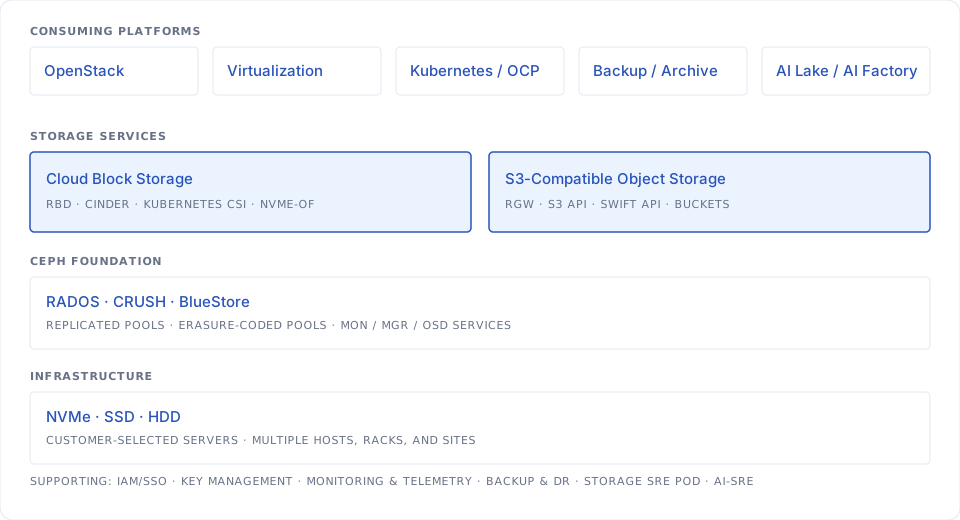
One foundation, four layers

From consuming platform down to physical media – how a single Ceph foundation serves block and object storage across your stack.
ONE FOUNDATION, TWO SERVICES

One storage foundation.
Two cloud storage services.


Applications don’t all consume storage the same way. Databases, virtual machines, and stateful containers generally need persistent block volumes. Cloud-native applications, backups, AI datasets, archives, and data platforms generally need object
storage.

Block storage is persistent, attachable storage for applications that need consistent I/O – think VMs, databases, stateful containers. Object storage is bucket-based, API-accessed storage – think backups, AI datasets, archives. XaasIO Storage delivers both from one Ceph-based foundation.

Cloud Block Storage

  • Persistent storage for VMs, databases, and stateful applications.

  • Attach, detach, resize, snapshot, and clone volumes

  • General-purpose, performance, and capacity-oriented profiles

  • Integrates with OpenStack Cinder, Nova, Glance, Kubernetes CSI, QEMU/libvirt, and NVMe-oF
Technical foundation: Ceph RBD

S3-Compatible Object Storage

  • Bucket-based storage for applications, backups, AI, analytics, and archives

  • Access through S3-compatible APIs, SDKs, and tools

  • Access keys, policies, quotas, versioning, lifecycle, and retention controls

  • Standard, capacity, immutable-retention, and archive-oriented
    profiles
Technical foundation: Ceph Object Gateway / RGW

XaasIO Block Storage provides a comparable cloud operating experience through Ceph RBD, Cinder, CSI, and NVMe-oF.

Workload Storage type Why
Virtual machine disks Block Persistent, attachable, predictable I/O
Relational database Block Consistent latency for transactional workloads
Stateful Kubernetes workload Block Ceph CSI provides consistent persistent volumes
Backup repository Object S3 API, lifecycle controls, versioning
AI training dataset Object Large, immutable files accessed via S3 tools
Data lake / lakehouse Object Bucket isolation, retention policies
Compliance archive Object Object Lock, immutable retention

PLATFORM COMPONENTS

Everything needed to deliver
storage as a cloud service
Block Storage
Create persistent volumes for VMs, databases, and containerized applications. Supports snapshots, rapid clones, resize operations, and service-profile selection.
Technical foundation: Ceph RBD

Object Storage

Create buckets and access data through S3-compatible APIs, SDKs, and applications. Apply quotas, policies, versioning, lifecycle, and retention controls.
RGW · S3-compatible API · Swift API

Data Placement & Protection

Place data across selected devices, hosts, racks, and sites according to required capacity, performance, and failure-domain policies.
RADOS · CRUSH · replicated & erasure-coded pools

Identity & Governance

Separate customers, departments, and workloads using identities, accounts, access keys, roles, policies, and quotas.
CephX · RGW IAM/STS · Keystone · OIDC

Management & Observability

Monitor capacity, health, latency, throughput, recovery activity, device condition, and storage utilization.
Ceph Manager · Dashboard · Prometheus · Grafana · XaasIO MLT
ACCESS METHODS

Consume storage the way your
platform already works

Consume XaasIO Storage through cloud APIs, Kubernetes storage classes, S3-compatible tools, standard automation interfaces, or the XaasIO management experience included in the deployment.

HOW IT WORKS

One request. Ceph places and protects the data.

01

Choose

Select a block-volume profile or object-storage class based on workload, performance, capacity, and retention requirements.
02

Authorize

XaasIO validates identity, permissions, quota, policy, encryption requirements, and available capacity.
03

Place

Ceph maps the data to the appropriate pool, media class, and failure domains per the validated CRUSH and protection design.
04

Deliver

Ceph exposes the completed service through RBD, Cinder, CSI, NVMe-oF, or the S3-compatible interface and continuously reports health and capacity.
Users request storage as a service. XaasIO and Ceph coordinate placement, protection, access, observability, and lifecycle operations.
SERVICE CLASSES

Storage profiles, not pool internals

Customer-friendly service classes – not internal Ceph pool structures.
Service-profile performance, usable capacity, recovery behavior, and availability depend on the validated hardware, network, media, data-protection policy, failure-domain design, and workload characteristics selected for each deployment. No specific IOPS, latency, or throughput figure is guaranteed on this page – request a validated architecture brief for deployment-specific numbers.

Block storage profiles

General Purpose Block


Balanced persistent storage for enterprise VMs, application servers, development environments, and common databases.

Performance Block


Low-latency, high-throughput storage for transactional databases, I/O-intensive applications, and performance-sensitive VMs.

Capacity Block


Capacity-oriented persistent storage where storage economics matter more than maximum I/O performance.

Object storage classes

Standard Object


Frequently accessed S3-compatible storage for applications, content, active backup repositories, and operational datasets.

Capacity Object


Capacity-efficient storage for data lakes, AI datasets, surveillance data, and backup repositories.

Immutable & Archive Object


Policy-controlled retention for backup, compliance, and long-term preservation using versioning, lifecycle, and Object Lock where included.

ADVANCED CAPABILITIES

Scale, protect, and govern data without
proprietary lock-in

Scale-Out Capacity


Expand capacity and performance by adding validated nodes and storage devices.

Failure-Domain-Aware Protection


Distribute data across devices, hosts, racks, and sites using replicated or erasure-coded pools.

Snapshots & Rapid Clones


Point-in-time block snapshots and copy-on-write clones for templates, testing, recovery, and application workflows.

Object Versioning & Lifecycle


Retain multiple object versions and automate data expiration or transitions between storage profiles.

Multi-Site Data Services


Asynchronous RBD mirroring and Ceph RGW multisite architectures per the validated DR design.

Encryption & Access Control


TLS, encrypted storage devices, RBD image encryption, object server-side encryption, and external key-management integration where included.

WORKLOAD USE CASES

One open storage platform for
cloud, data, and AI

OpenStack & VMware Exit


Persistent VM disks, cloud images, Cinder volumes, and backup repositories for OpenStack private clouds and VMware exit programs.

Enterprise Virtualization & HCI


Ceph-backed converged or hyperconverged storage for long-lived Windows and Linux workloads.

Kubernetes & OpenShift


Persistent storage for stateful Kubernetes and OpenShift applications using Ceph CSI or a validated Rook-Ceph architecture.

AI Lake & Data Platforms


Storage for documents, media, training datasets, model artifacts, checkpoints, RAG content, and lakehouse data.

MSP & Cloud Provider Storage


Tenant-aware block and object storage with profiles, quotas, metering, billing, and managed operations.

Backup, Archive &
Immutable Retention


S3-compatible object storage for backup targets, historical data, retention policies, versioning, and Object Lock.

PLANNING TOOL

Estimate usable capacity

Raw device capacity is not usable capacity. Enter a raw pool size and a protection scheme to see the approximate usable result – the same trade-off XaasIO validates in every architecture engagement.

Ceph storage capacity calculator

Usable capacity
33.3 TB
Overhead
66.7%
Simplified planning estimate only – excludes recovery headroom, metadata, and per-workload sizing. A Ceph Storage Assessment produces validated numbers for your environment.
DEPLOYMENT MODELS

Choose the architecture that fits the workload

Dedicated Ceph Storage

Dedicated storage nodes with independent capacity, performance, and lifecycle management.

Converged Cloud Storage

A shared Ceph platform serving OpenStack, Kubernetes, virtualization, backup, data, and AI workloads.

Hyperconverged Infrastructure

KVM compute and Ceph storage services operating on the same validated infrastructure nodes.

Kubernetes-Managed Ceph

Ceph is deployed and managed through Rook, where Kubernetes-native lifecycle management is appropriate.

AVAILABILITY, BACKUP & DR

Availability, backup, and DR are separate capabilities


Ceph provides strong foundations for placement, redundancy, self-healing, snapshots, and replication. XaasIO designs availability, backup, immutability, recovery-point objectives, and recovery-time objectives as separate but connected policies.

Local Resilience

Replicated or erasure-coded pools, defined failure domains, checksums, scrubbing, recovery, and rebalancing.

Block Storage DR

Asynchronous replication of selected RBD volumes between separate Ceph clusters.

Object Storage DR

Ceph RGW multisite and bucket-level synchronization policies for selected object data.

Backup & Immutability

Snapshots, external backup workflows, object versioning, Object Lock, and independently controlled backup copies.

OPERATING MODEL

Ceph without the integration burden

XaasIO designs, deploys, validates, and supports Ceph as one production storage platform rather than an unsupported collection of components, scripts, and hardware.

Validated Architecture

Hardware, network, failure domains, pools, protection policies, gateways, and platform integrations validated as one architecture.

Controlled Lifecycle

Documented release, patching, upgrade, compatibility, rollback, and maintenance procedures.

Secure & Sovereign

Customer-controlled hardware, identity, software repositories, encryption, key management, monitoring, logging, and update procedures.

Flexible Operating Model

Customer-operated, co-managed, fully managed, or dedicated XaasIO Storage SRE Pod.

AUTONOMOUS OPERATIONS

Do more with less: autonomous operations for storage

Add XaasIO MLT, SRE Pod, and AI-SRE to move from reactive storage administration toward policy-driven, assisted, and increasingly automated Ceph operations.

Cluster health & incident triage

Capacity forecasting

Device-health analysis

Failed-device replacement guidance

Recovery & rebalancing runbooks

Maintenance preparation

Patch & upgrade readiness

Pre/post-change validation

Backup & DR verification

Human-approved automation

Advanced Storage Support Packs

Rook-Ceph for Kubernetes

Ceph NVMe-oF Gateway

S3 Migration & Compatibility

Ceph Multisite & DR

Optional CephFS & NFS

External Storage Integration


Separately scoped architecture, migration, integration, and managed-support services.

BLOCK VS OBJECT

XaasIO Block Storage or XaasIO Object Storage?
Both. On One Platform.

Dimension
Block storage
Object storage
Operating model
Cloud volume service
Cloud bucket service
Data access
Persistent volumes (mount as /dev/xxx)
S3-compatible APIs (HTTP)
Typical workload
VMs, databases, I/O-intensive
Cloud-native apps, backups, AI/data
Consistency model
Strong (ACID-friendly)
Eventual (blob-storage)
Performance profile
Low-latency, high-IOPS
Throughput-optimized, cost-efficient
Typical object size
Volumes: 10 GB – 10 TB
Objects: 1 KB – 100 GB
Snapshots/versions
✓ RBD snapshots
✓ Versioning + Object Lock
Multi-tenancy
Per-volume ACLs
Per-bucket policies + namespaces
Encryption
RBD image encryption
S3 server-side encryption
KEY TERMS

Glossary

Ceph terms used on this page

RADOS

Ceph’s core distributed object store – the reliable storage layer beneath both block and object services.

CRUSH

The algorithm Ceph uses to determine data placement across devices, hosts, racks, and sites.

RBD

Ceph Block Device – the block-storage interface for persistent VM and container volumes.

RGW

Ceph Object Gateway – the S3- and Swift-compatible object storage interface.

BlueStore

Ceph’s storage backend engine that writes data directly to raw block devices.

OSD

Object Storage Daemon – stores data on a single device and handles replication, recovery, and rebalancing.

Data residency

The physical and jurisdictional location where data is stored and processed – determined by where you deploy XaasIO Storage infrastructure.

Frequently asked questions


What is XaasIO Block and Object Storage?

A Ceph-based platform delivering persistent block volumes through Ceph RBD and S3-compatible object storage through Ceph Object Gateway, integrated with OpenStack,Kubernetes, virtualization, backup, and AI platforms.

Is Ceph the default XaasIO storage platform?

Yes. Ceph RBD and RGW are the standard platforms; other storage technologies are supported only through separately scoped Advanced Storage Support Packs.

What is the difference between block and object storage?

Block storage provides persistent, attachable volumes for applications like databases and virtual machines. Object storage provides bucket-based storage accessed through APIs, used for backups, AI datasets, and archives. XaasIO Storage delivers both from one Ceph foundation.

Is XaasIO Object Storage compatible with Amazon S3?

XaasIO Object Storage is S3-compatible: it supports the S3 API through Ceph Object Gateway, so tools like the AWS CLI, boto3, and Terraform work against it. It does not support AWS-only services such as CloudFront or Lambda triggers.

Is XaasIO Block Storage compatible with Amazon EBS?

No. XaasIO Block Storage is not “EBS-compatible.” It provides a comparable cloud storage experience through Ceph RBD, Cinder, CSI, and NVMe-oF.

Does XaasIO Storage integrate with OpenStack?

Yes, through Cinder, Glance, Nova, and Keystone.

Can Kubernetes and OpenShift use XaasIO Storage?

Yes, through Ceph CSI or an optional Rook-managed Ceph architecture.

Does it support snapshots and clones?

Yes. Block storage supports point-in-time snapshots and copy-on-write clones. Snapshots do not replace an independently designed backup strategy.

Does it support immutable object storage?

Yes, where included in the validated design, through versioning, lifecycle policies, and Object Lock.

How is data encrypted?

TLS in transit; encrypted storage devices, RBD image encryption, and object server-side encryption at rest; supports external key-management integration.

How does disaster recovery work?

XaasIO separates disaster recovery from everyday resilience. Block volumes use asynchronous Ceph RBD mirroring between clusters; object data uses Ceph RGW multisite replication. Neither replaces an independently tested backup.

Can Ceph use NVMe, SSD, and HDD?

Yes. Media selection and placement are defined per validated architecture and workload requirement.

How does XaasIO Storage scale?

By adding validated nodes and storage devices, Ceph rebalances data across the expanded cluster according to the CRUSH policy.

Can it operate in an air-gapped environment?

Yes, where the deployment is validated for disconnected operation, customer-controlled software repositories, and local identity and monitoring.

Are other XaasIO modules required?

No. XaasIO Storage operates independently. XaasIO Compute, Virtualization, Managed Kubernetes, AI Lake, and Hyperscaler Platform are optional integrations.

How is XaasIO Storage different from AWS S3 and EBS?

XaasIO Storage runs on infrastructure you own rather than a hyperscaler’s, so there is no egress fee and data stays inside your compliance boundary. It is S3-API-compatible for object storage; block storage is Ceph RBD-based rather than EBS-compatible.

How does XaasIO Storage compare to Nutanix?

Nutanix sells hyperconverged infrastructure that fuses compute and storage into one licensed stack. XaasIO Storage is disaggregated, open-standard Ceph that can scale independently of compute and doesn’t require adopting a single vendor’s hypervisor.

How does XaasIO Storage compare to Platform9?

Platform9 focuses on managed control-plane operations across multiple infrastructure types. XaasIO Storage focuses specifically on the storage layer — Ceph architecture, lifecycle, and SRE — and can sit underneath a Platform9-managed or any other control plane.

How does XaasIO Storage compare to Mirantis?

Both are Ceph-adjacent. The difference is operating model: XaasIO scopes storage as an independently consumable service with its own SRE pod and validated architecture, rather than bundling storage into a broader OpenStack or Kubernetes distribution.

Is XaasIO Storage SOC 2 or HIPAA compliant?

XaasIO Storage is architected with controls designed to align with SOC 2, HIPAA, and CMMC control families. Confirm current formal certification status directly with XaasIO before relying on it for a compliance decision.

Plan a Ceph storage architecture around your workloads

Assess capacity, performance, failure domains, usable storage requirements, S3 compatibility, data protection, migration, and operations. XaasIO will propose a practical architecture with service classes, hardware requirements, growth assumptions, recovery objectives, and a phased production plan.